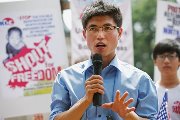
 North Korea refugee and prison camp survivor Shin Dong-hyuk speaks during a rally outside the White House while demonstrationg for human rights in North Korea in Washington, D.C. on July 10, 2012. Human rights advocates released the most current data on abuses in North Korea, noting that the data are key as the regime tries to cover its tracks. (Chip Somodevilla/Getty Images) North Korea refugee and prison camp survivor Shin Dong-hyuk speaks during a rally outside the White House while demonstrationg for human rights in North Korea in Washington, D.C. on July 10, 2012. Human rights advocates released the most current data on abuses in North Korea, noting that the data are key as the regime tries to cover its tracks. (Chip Somodevilla/Getty Images)
|
 Documenting Human Rights Violations in North Korea Documenting Human Rights Violations in North Korea
WASHINGTON—North Korea has long been a pariah state with its internment camps and social stratification system. Despite its secrecy and isolation, the “hermit” kingdom has always been watched and analyzed by human rights organizations. In recent years, the wall of secrecy has been breached.
With the aid of satellite imagery and interviews with thousands of North Korean defectors, steady progress is being made in collecting data on the crimes of the state against its people—data that could be used in future trials, say human rights advocates.
The regime denies any human rights issues exist. “The so-called political prisoner’s camps do not exist,” a representative of the Democratic People’s Republic of Korea (DPRK or North Korea) told the U.N. Human Rights Council on Dec. 9, 2009, as cited in the “Hidden Gulag” by David Hawk.
Amnesty International estimates that between 150,000 and 200,000 political prisoners are incarcerated in North Korea.
Some 23,000 North Koreans who have taken refuge in South Korea give testimony that severe human rights violations in North Korea are ongoing.
Gershman said it began in the 1990s with famine and the resulting breakdown of the public distribution system—a private market evolved out of necessity.
“Participation in markets is an everyday form of resistance,” Gershman said.
The new informal market economy enabled North Korea’s most famous prison fugitive Shin Dong-hyuk to survive when he escaped Camp 14 where he was born.
Shin was featured recently on “60 Minutes,” where he described a life of slavery, and perpetual hunger. He witnessed many atrocities, including the execution of his mother and brother. At age 23, he fled the camp—the only world he had known—and eventually found freedom in South Korea.
Shin was held in the camp because his father’s two brothers had defected to South Korea. The sentence, unusual by Western standards, was based on feudal penal practices of the Chosun Dynasty (1392–1897) revived by the communist regime.
Up to three generations can be incarcerated based on a philosophy of “collective responsibility” or “guilt by association.” One-third of the population is designated as disloyal to the regime and receives severe punishment.
Shin could find cover, food, and shelter in Korean society because the country now tolerates smuggling and petty bribery. “Something is definitely changing in North Korea. It’s not the North Korea of the ’80s or ’90s,” Gershman said.
North Korea is no longer the hermit country it once was; it knows the world is watching.
Gershman quoted the book, “Escape from Camp 14: One Man’s Remarkable Odyssey from North Korea to Freedom in the West,” where author Blaine Harden quotes Shin: “It’s just a matter of time, Shin told me, before North Korea decides to destroy the camp. I hope the United States, through pressure and persuasion, … [can] convince the North Korean government not to murder all those people in the camp.”
“I don’t think they would hesitate to kill all of [the prisoners] because they are evidence … as the world becomes more aware of what is going on.”
(2012-12-20/theepochtimes)
|

 首頁
首頁  聯絡我們
聯絡我們