 Pablo Martinez Monsivais
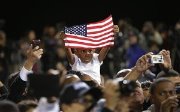
A young supporter holds up a U.S. flag during a campaign event for President Barack Obama at Doolittle Park, Wednesday, Oct. 24, 2012, in Las Vegas. Pablo Martinez Monsivais
A young supporter holds up a U.S. flag during a campaign event for President Barack Obama at Doolittle Park, Wednesday, Oct. 24, 2012, in Las Vegas.
|
 Guns, climate, gays missing in presidential race Guns, climate, gays missing in presidential race
WASHINGTON -- Of the roughly 50,000 words spoken in this month's three presidential debates, none were "climate change," "global warming" or "greenhouse gas."
Housing was discussed in the first debate, but the word "foreclosure" was mentioned in none. Nor was gay marriage.
The 2012 presidential campaign, not just the debates, has focused heavily from the start on jobs, pushing other once high-profile issues to the sidelines. It dismays activists who have spent decades promoting environmental issues, gay rights, gun control and other topics, sometimes managing to lift them to the top tiers of national attention and debate.
With fewer than half of Americans believing that human activity contributes to global warming, according to Pew Research, President Barack Obama talks far less about climate change than he did four years ago. When he locked up the Democratic nomination in June 2008, he said future generations would recall "this was the moment when the rise of the oceans began to slow and our planet began to heal."
Obama hasn't come close to making such claims in recent months.
Last June, 3,100 U.S. temperature records were broken and much of the nation was in drought, said Daniel Kessler, spokesman for 350 Action Fund, which tries to raise awareness of global warming. And yet the three presidential debates, and the sole vice presidential forum, produced "absolute silence on climate science," Kessler said.
He said he believes voters would respond favorably "if candidates put out a bold vision" on climate change. Instead, the topic generates far less discussion than it did four years ago. Other topics suffering downgrades in presidential campaign attention include:
GUNS
Gun rights sometimes have played big roles in U.S. elections. In 1993, for instance, the recently elected President Bill Clinton signed the Brady Bill, which required background checks on many gun buyers. A new ban on assault weapons soon followed. But it contributed to heavy Democratic congressional losses in 1994, and the law expired 10 years later.
Despite high-profile mass shootings - including those involving Rep. Gabrielle Giffords in early 2011, and dozens of Colorado movie theater patrons in July - questions about gun rights and gun control have generated scant discussion this year.
They weren't mentioned in the first debate between Obama and Republican Mitt Romney, which focused on domestic issues. A voter asked about assault weapons in the second, town-hall-style debate, on Oct. 16.
Obama cautiously spoke of "seeing if we can get an assault weapons ban reintroduced." Romney said he favors no new gun laws.
The Brady Campaign to Prevent Gun Violence criticized the lack of discussion in the first debate. After the second, it chiefly praised the woman who asked about the assault weapons ban.
IMMIGRATION
In recent years, immigration has been a big issue in national elections. Then-Texas Gov. George W. Bush backed a pathway to legal status for many illegal immigrants when he ran for president in 2000. But Republican activists and members of Congress increasingly took hard stands against illegal immigrants.
In this year's Republican primaries, Romney positioned himself to the right of Texas Gov. Rick Perry, former Speaker Newt Gingrich and others when it came to being tough on illegal immigration. He said illegal immigrants should be encouraged to "self-deport."
Romney has softened his rhetoric somewhat since then.
He told Hispanic leaders in June he would replace Obama's executive order allowing 800,000 young illegal immigrants to remain in the country with a long-term solution. But Romney didn't detail his plans, and immigration has played a smaller role in the general election than it did in the primary.
GAY RIGHTS
The gay rights advocacy group Human Rights Campaign recently noted on its website that questions of same-sex marriage and other gay rights issues were not mentioned in the first two presidential debates and the vice presidential debate. The final Obama-Romney faceoff was likely to be "the last window for the candidates to share their vastly different views" on the topic, the group said.
But that debate, on Oct. 22, also came and went with no mention of "gay" or "same-sex" - or any type of marriage, for that matter.
That's not to say the nominees haven't taken stands. Early in his term, Obama helped clear the way for gays and lesbians to serve openly in the military. Last May he embraced same-sex marriage, which Romney opposes.
The gay-oriented group Log Cabin Republicans gave Romney a somewhat tepid endorsement. "If LGBT (lesbian, gay, bisexual, transgender) issues are a voter's highest or only priority, then Governor Romney may not be that voter's choice," the Log Cabin Republicans endorsement said. The group said it believed Romney would do a better job of cutting spending and creating jobs.
Those are precisely the issues that have dominated the campaign, often in basic discussions that don't go far beyond platitudes. Both campaigns have warned of the looming "fiscal cliff" - the package of huge tax hikes and spending cuts scheduled to hit Jan. 1 - but no one has come close to offering a viable solution.
Meanwhile, advocates for improving schools, fighting poverty, fighting crime and other issues - which have played big roles in past elections - have struggled to get a word in edgewise this year.
When U.S. unemployment exceeded 10 percent in October 2009, politicians said the 2012 election would be about jobs, jobs, jobs. Three years later, that hasn't changed.
(2012-10-25/kansascity)
|


 首頁
首頁  聯絡我們
聯絡我們