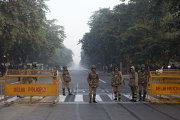
 New Delhi police officers stand guard at a check point on Sunday after security was increased following the death of a rape victim. New Delhi police officers stand guard at a check point on Sunday after security was increased following the death of a rape victim.
|
 Rape Victim's Body Returns for Delhi Cremation Rape Victim's Body Returns for Delhi Cremation
NEW DELHI—The body of the rape victim whose death has unleashed a wave of anger and grief in India was flown back to New Delhi early Sunday from Singapore and was received by Prime Minister Manmohan Singh and Congress party President Sonia Gandhi , a government spokeswoman said.
The 23-year-old victim, who hasn't been identified by authorities, had been receiving specialized treatment at a hospital in Singapore's Mount Elizabeth Hospital before she died on Saturday, succumbing to severe organ failure. Within hours of returning home aboard a special Air India aircraft, the body was taken to the victim's Delhi residence for a cremation witnessed by a battery of senior Indian officials, according to Press Trust of India.
The gang-rape of the woman on Dec. 16 and her untimely death have shaken the national conscience. Six men picked up the woman and her male companion in a chartered bus, brutally beat them as they drove around South Delhi, and stripped them before throwing them out of the vehicle, police said. Following the woman's death, police slapped murder charges on the six alleged perpetrators, who are in judicial custody.
The male companion, a software engineer who also hasn't been publicly identified, was treated for injuries and later released from the hospital.
On Saturday, men and women took to the streets across the country in peaceful protests and candlelight vigils. Protesters are voicing anger that police aren't providing adequate security for women and are pushing the government to speed up the judicial process in India's pending rape cases, which women's activists estimate at between 40,000 and 100,000. Some are calling on Parliament to hold a special session to address the issue.
There were 24,206 rape cases registered in India in 2011, according to the National Crimes Record Bureau. But the number of convictions of alleged rapists occurred in only a quarter of cases, the statistics show.
Political leaders pledged to reform the laws and called on protesters to remain calm, while acknowledging their message. Two official inquiries are looking into potential changes to rape laws and whether authorities committed major lapses in the Dec. 16 case. "I want to assure you that your voice has been heard," Mrs. Gandhi, arguably India's most powerful political figure, said in a televised statement.
The question is whether such assurances will be enough to satisfy the huge numbers of Indians who say they are fed up with political rhetoric and promises and are looking for concrete solutions to improve safety in a nation where an evening commute aboard a bus or a nighttime walk down a city street is a scary endeavor for many women.
Protesters have called for a number of legal and administrative steps to address the issue. Among the proposals is to make rape a crime punishable with the death penalty. The murder charge in the Dec. 16 case allows authorities to seek capital punishment for the accused, but in stand-alone rape cases, the sentence can range from seven years to life imprisonment.
Some activists are also calling for a broad sexual assault law that cracks down on groping and other misbehavior with women—often euphemistically referred to as "eve-teasing" by authorities. And others have proposed administrative reforms that would require police to register legal complaints by rape victims within a certain time frame or be punished. Activists say in many cases policy try to dissuade women from filing cases, and some experts say as many as half of the country's rapes never go reported.
Human Rights Watch, in a report released Sunday in India, points to the so-called "two-finger test" as evidence of how India had failed to take rape seriously, often blaming women's behavior for the offense. In the test, which appears in Indian jurisprudence textbooks and is admissible in court, a doctor inserts two fingers into a women's vagina to determine its laxity and whether the hymen is broken, signaling previous sexual activity.
The test perpetuates stereotypes of rape survivors as loose women and often is used by defense counsels to achieve acquittals, human-rights groups say.
(2012-12-30/wsj)
|


 首頁
首頁  聯絡我們
聯絡我們