 China Human Rights Crackdown on Environmental Protests Along Class Lines China Human Rights Crackdown on Environmental Protests Along Class Lines
|
 China Human Rights: Crackdown on Environmental Protests Reveal Class Divide China Human Rights: Crackdown on Environmental Protests Reveal Class Divide
With the rise of an educated middle class in China, many are starting to obtain public ideological awareness. Despite what most political scientists predict, Chinese citizens are starting to make connections between bad local governance and their country’s one-party system.
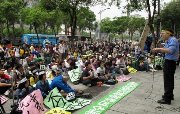
“It is the 4th of July – 236 years ago America achieved independence, and 236 years later the Shifang people are fighting for their own rights and confronting the government,” wrote one microblogger. On the same day, Shifang residents marched onto the streets and protested the planned construction of a heavy-metals refinery by a corporation called Sichuan Hongda. The residents were concerned about the refinery's environmental impact and safety risks, as the plant would sit in a seismically active region. In 2008, a massive earthquake in Sichuan caused the collapse of two chemical factories in Shifang, releasing clouds of poisonous gas into the city. The protest successfully forced Sichuan Hongda to suspend construction, a move that sent their share price tumbling.
In recent years, environmental public discourse disputes between local government and the residents have been more frequent. There have been other not-in-my-backyard protests in China: in 2009, local residents stopped the construction of a garbage incinerator in Guangzhou and a high-speed rail line in Shanghai; last year, other protesters halted the paraxylene plant construction in Dalian. Investors, both foreign and domestic, usually used the Chinese system to make deals with local cadres without worrying about what the laobaixing - the public – thought. With the right amount of money, investors could easily clear peasants off the land to make way for chemical plants that spew out carcinogens, golf courses, or single-family mansions. However, this is no longer the case for many growing cities. As the middle class begins to get better education and take more white-collar jobs, the public becomes less tolerant of the local government’s actions.
Nonetheless, it still matters who is protesting. For instance, in 2011, tens of thousands of students and white-collar workers successfully halted the construction of Fujia factory’s $1.5bn modern facility that produced paraxylene (a mildly toxic chemical in plastics) by holding a large, peaceful protest in Dalian. The protest was organized via mobile phones and the Internet – covered by domestic and foreign media. Police officers even gave directions to those looking for the rally. Dalian, Shanghai, Guangzhou, and Shifang are all considered first or second-tier cities – cities with a growing vocal middle class.
On the contrary, villages suffer more. Xinglong, which is in one of China’s poorest provinces (Yunnan), has not been able to prevent unwanted construction. The Luliang Chemical factory has dumped more than 5,000 tons of waste chromium – a known carcinogen – in the Nanpan river, water that local farmers of Yunnan use for farming purposes. Local doctors and citizens have been complaining for years about the discharges from the chemical factory, as well as other harmful factories in the Luliang Industrial Park. But the Yunnan environmental department appears powerless. The well the village uses is red and yellow, and the cattle drink poisonous river water. When the villagers protested, the government ignored or arrested them, then gave them paltry compensation.
So what has caused such polar responses from the government? Surely, the size of the protest is relevant. The protesters in Dalian and other cities are several times bigger than the entire population of Xinglong. It’s much easier to ignore scandals in the countryside, but not in international economic hubs. Most importantly, the government's response depends on who is protesting, what they are opposing, and how much their local economies have developed. Far from its ideology, the Chinese Communist party is clearly more concerned about creating clean urban environment for the rising middle class than protecting old rural villages for farming masses. It’s not too surprising, as this perspective falls in line with the country's aspirations for overall development.
(2012-07-17/policymic)
|

 首頁
首頁  聯絡我們
聯絡我們