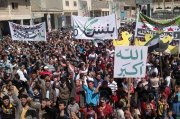
 Demonstrators protested against President Bashar Assad of Syria after Friday prayers in Binsh. The UN has estimated that more than 8,000 people have been killed in the Syrian conflict. Demonstrators protested against President Bashar Assad of Syria after Friday prayers in Binsh. The UN has estimated that more than 8,000 people have been killed in the Syrian conflict.
|
 Updated UN report reveals more rights abuses in Syria Updated UN report reveals more rights abuses in Syria
A UN inquiry commission on rights abuses in the Syria conflict offered grim new details Friday of the government repression in that country, including the uprooting of extended clans and villages forced to flee into neighboring countries by armed forces bent on crushing armed resistance.
The three-member commission, which released its first highly incriminating report on rights abuses in Syria in November, told a news conference it had a fuller picture of what had been happening inside Syria in an updated report based partly on the refugee flows.
“There are people coming out in greater numbers,’’ said Karen Koning AbuZayd, a panel member. While refugees in the early days of the conflict went across borders often by themselves or with their families, she said, “people are now coming out in whole groups.’’
Members said refugees had told them that in some cases, entire villages had been warned by advancing military columns that suspected insurgents hiding in their midst must surrender or the villages would be shelled. They did not identify any villages by name.
Sergio Pinheiro, the chairman of the commission, said the pattern of killings in the Syrian conflict also had shifted: While most of the deaths in the early months were from clashes between security forces and unarmed protesters at antigovernment demonstrations, many more are now from shelling and shootings by military units deployed to rout insurgents hiding among civilians.
At least 16,000 Syrians have fled to Turkey, 15,000 to Lebanon, and an unspecified number to Jordan, the panelists said at the news conference at the United Nations. They said they suspected that thousands more Syrian refugees were also in these countries but had not registered out of fear that Syrian security forces would take revenge on relatives back home.
Yakin Erturk, a commission member, said some refugees had told investigators of far-reaching efforts by security forces to cover up misdeeds when Arab League monitors were visiting Syria earlier this year. In one example, she said, doctors at hospitals in the city of Aleppo had been ordered to tranquilize patients who had been tortured so they could not speak to the visiting monitors. She said investigators were trying to learn more about this.
The government of President Bashar Assad has refused to allow the commission into Syria. The commission members said they had based their findings on extensive interviews with more than 400 refugees, aerial surveillance data, and other evidence.
Pinheiro said the commission’s updated report on Syria also included government assertions of killings and rights abuses committed by the opposition but that investigators had no way of corroborating those assertions without access inside Syria.
The United Nations has estimated that more than 8,000 people have been killed in the Syrian conflict.
In an update given to the Human Rights Council in Geneva this month, Pinheiro said the dead included more than 500 children, calling it a “tragic indicator of the human rights conditions in areas of unrest.’’
He also revealed then that the commission had assembled a confidential list of “particular individuals’’ who may be the subject of war-crime investigations. The commission has declined to make that list public.
Earlier Friday, the European Union expanded sanctions on Syria and placed a travel ban on Assad’s family, including his wife, Asma, diplomats said.
The decision by Europe’s foreign ministers in Brussels to impose a limited expansion of commercial sanctions is aimed at tightening the economic squeeze on the government in Damascus and forcing an end to its crackdown.
(2012-03-24/bostonglobe)
|


 首頁
首頁  聯絡我們
聯絡我們