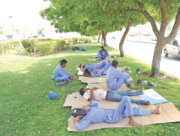
It’s time to defend the human rights
|
 Express yourself: It’s time to defend the human rights
The Sultanate of Oman has earned a global recognition for its excellent human rights record and for ensuring rights of both its citizens and the over 600,000 expatriates working in the country. So, the logical corollary is that blue-collar workers, too, are provided with the same level of administrative support.
But some of them are having to work outdoors in the oppressive summer heat as some companies are bent on flouting the mid-day break rule for labourers during the peak summer time. Article 16 of the Omani Labour Law clearly states that labourers cannot be made to work outdoors between 11am and 4pm from June 1 to the end of August.
This legal protection has been provided to the workers as it is a medical fact that overheating of the body could lead to heat stress and dehydration. Although the legal provisions are in place, much still needs to be done to implement these regulations. The private companies and the government departments flouting these rules ought to be hauled up. It is time for us to ring the alarm bells and take up the cudgels to defend the human rights of workers.
It is in this light that we invited our readers to express their opinion on the issue, and as we expected, they have all hailed the Sultanate’s excellent human rights record, while urging the authorities to take to task those who flagrantly violate the laws of the land and care a little about the image of the country.
George Mathew
Madinat Qaboos
Walking in the open — even for a few minutes — in this scorching heat is quite an unpleasant experience. But still we see a large number of workers, both citizens and expatriates, especially those in the construction business, have to toil the entire day in extremely difficult weather conditions.
This exploitation is rampant despite rules clearly stating that certain hours of the summer days are to be earmarked for mid-day break.
The Ministry of Manpower introduced the mid-day summer break for blue-collared workers in 2008 but still we can see several companies flouting the rules.
According to me, it is simply inhuman to make the workers work during that time. While talking to workers, I came to know that some companies continue to give the regulations the go-by and are forcing the workers to work in such life-sapping conditions. The Sultanate has enough rules to ensure mid-day break for blue-collared workers.
Now, what the government has to do is to make sure that the rules are not violated. The officials concerned should carry out surprise visits to the construction sites.
If they find that companies are violating the rules, then those companies should be given moral punishment.
Recently, I read that oil and gas officials in the Sultanate have asked that their sector be exempt from the mid-day break rule for workers, as it is costing the industry ‘millions of dollars’. We should not forget that the law, which states that no employees are to work outside between 12.30 and 3.30pm during the peak summer months, was implemented for the welfare of the workers.
Originally, the rule was applied to construction workers, but later it became law for the oil and gas sector after a series of industry-wide protests were organised.
Citing the loss of ‘millions of dollars’, companies should not play with the life of poor workers. I agree that there will be some emergency situations, where the mid-day break rules cannot be followed. In that case, according to me, employers must provide enough cold water, lemon, salt and healthy salads during working hours for the workers.
Sam Abdul Khader
Al Khuwair
Gulf countries by virtue of their geographic location bear the brunt of scorching sun for a major part of the year with its effects peaking in the months of May to August. There is no denying the fact that companies must adhere to the mid-day break rules.
However, I would like to take this opportunity to quote extensively from OSHA (Occupational Safety and Health Administration) guidelines to elucidate some of the suggested practices of OSHA in overcoming heat related stress and ailments. There is a general tendency to apply the mid- day break rule only to outdoor construction activities.
Even though outdoor construction workers are the worst affected there are a host of other workplaces such as iron and steel foundries, nonferrous foundries, brick-firing and ceramic plants, glass products facilities, rubber products factories, electrical utilities (particularly boiler rooms), bakeries, confectioneries, commercial kitchens, laundries, chemical plants, mining sites, smelters etc., which are equally hot and humid especially during the peak summer months.
People exposed to high temperatures suffer from heat stroke, heat exhaustion, heat cramps, heat rashes, heat fatigue etc. Rest times for individual categories of workers should be evaluated in more scientific terms. Ventilation, air cooling, fans, shielding, and insulation are the five major types of engineering controls used to reduce heat stress in hot work environments.
Heat reduction can also be achieved by using power assists and tools that reduce the physical demands placed on a worker. Skilled and unskilled labourers are the back bones of Oman’s economic development and all possible steps should be taken for their wellbeing.
Usha Devi Suddapalli
Ruwi
The Sultanate of Oman, which is one among the active member nations of the UN, is a signatory to many of the pacts of International Labour Organisation (ILO). The very first ILO convention adopted in 1919 had provisions on regulating working hours in varied climatic times to safeguard workers. Countries worldwide have formulated enforceable regulations on mid-day break for long, which are subjected to judicial review. The US Supreme Court recently came out heavily on Arizona federal government for its failure to properly oversee such norms.
Under the progressive leadership of His Majesty Sultan Qaboos bin Said provisions on mandating a mid-day break have been made. The Ministry of Labour has a key role in implementing these norms and so it is expected that these regulations are strictly imposed.
The authorities concerned ideally seek periodical compliance for the relevant employers by making them introduce work-rest-regimen, audit the workplace to identify heat stress areas, oversee if protective clothing, caps, cooling drinking water, shades are provided and besides making them accountable by a regulated administrative control as well. The psycho-physiological effects of heat stress not only impacts work efficiency. but also adds to health care costs.
Oman, with its greater impetus on infrastructure development has many ongoing works like airport developments, ports, laying huge stretches of roads/highways, building construction, industrial constructions; with parallel outdoor works by private establishments; not to be left out the agriculture sector, notably the date tree cultivating.
It is highly incumbent on the part of the employers as well authorities to see that the desired effects of the mid-day break reach the targeted class. Lastly, but more importantly, it lends a humane touch to the deserved class of citizens and expatriates who contribute a lot to the nation’s development by their hard laboured sweat.
Khalid Mumtaz
Muttrah
The plight of the workers, slogging it out in the summer heat is pathetic and calls for immediate intervention from the government authorities. It is a medical fact that in temperatures above 40 degrees Celsius it is humanly difficult for even a healthy man to do physical work.
But in the Sultanate it is a common sight to see workers in their blue and yellow overalls sweating it out in the construction sites.
Despite government regulations the orders are blatantly flouted. It is a common sight to see expatriate workers out in the sweltering heat; and that to for a pittance of a salary, which hardly exceeds RO150 per month.
A report in your newspaper had headlined ‘Some firms continue to flout mid-day break regulation’. In that news article a construction worker had said: “Some of my colleagues suffered exhaustion and had to be admitted to hospital due dehydration”.
Any doctor would tell you that cases of dehydration amongst workers is very common during the summer months, when the temperatures can hit the 50 degree Celsius mark. So now its time for the government authorities to clamp down on the defaulting companies and government departments and stringently implement its mid-day break regulation.
Next hot topic: Should the believers take care not to over-eat after breaking their fast during the Holy Month of Ramadan?
Send us your views and comments with your picture on
editor@timesofoman.com
webeditor@timesofoman.com
(2011-7-31/timesofoman)
|


 首頁
首頁  聯絡我們
聯絡我們